
HR Leaders Replace Org Charts With ‘Work Charts’ To Make AI Adoption Pay Off

“You have to start thinking about work redesign and not org design because you have agents and you have humans and both of them are coming together to solve a problem. How do you make sure that they are all working under the same context?”

Shlomit Gruman-Navot
Co-Founder
Practi
The org chart was built for people. Now half the work is being done by something it can’t even show. The tools are everywhere, the shadow AI is sanctioned, the licenses are bought, and none of it has translated into the results leaders expected. Usage is high and the return is missing. Instead of humans and agents working together, employees are finishing their own tasks and then double-checking whatever the agent produced, which is just more work wearing a different hat. Another tool won’t fix it. Neither will another hire. The move is to throw out the org chart and draw something that can actually show how humans and agents share the work.
Shlomit Gruman-Navot is the Co-Founder of Practi, a peer-learning community for professionals navigating workplace change. With 25 years across tech, SaaS, and banking, including 13 years as a Chief People Officer, she scaled the OLX Group from 3,000 to 11,000 employees across more than 30 markets and led the people function at Miro. She approaches AI adoption as a large-scale change-management exercise, and her starting point is that the org chart no longer fits the work.
“You have to start thinking about work redesign and not org design because you have agents and you have humans and both of them are coming together to solve a problem. How do you make sure that they are all working under the same context?” Gruman-Navot says. The org chart organizes people by levels and layers. It has no way to represent an agent performing real work, leaving no shared document that defines where human judgment is required, where humans and agents collaborate, and where work can run on its own.
Painting a work chart
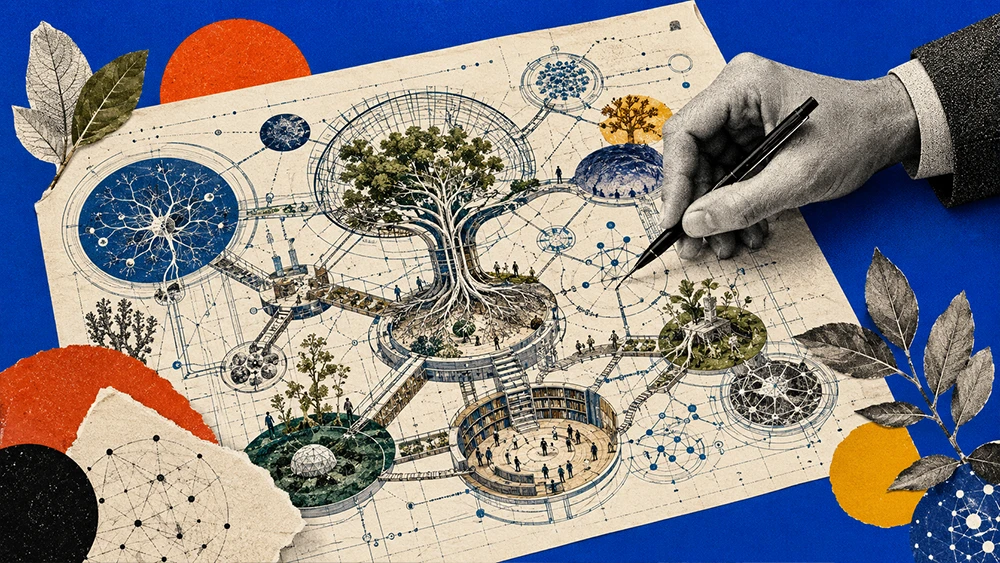
Her alternative is a map that puts people and software on the same page. “You have to paint a very different org chart. You have to create a work chart that includes humans and agents, and you have to bring it all together. So you have to be several steps ahead,” she says.
The shift sounds abstract until its consequences become apparent. Workloads double because employees check agent output on top of finishing their own tasks, and organizations respond by either pulling back on automation or adding people. Both responses miss the actual problem: nobody decided in advance which parts of the work the agent owns.
The first place that confusion surfaces is the invoice. “Employees are burning tokens, but then comes the question: what is the outcome? What’s the output?” Gruman-Navot says. “How do we measure efficiencies and effectiveness, whether it should be time to decisions, time to market, sales efficiency, or recruitment productivity. That’s what companies are now trying to figure out.” Counting tokens is trivial, but proving they bought anything is the part most organizations still can’t crack, and it is exactly what a work chart forces into the open.
Make it boring first
Forget measurement for a second. Plenty of people are still using these tools incorrectly. “The first level of AI fluency isn’t a lack of knowledge. It is working in the wrong way with AI,” she notes. “That’s the worst that can happen because then you’re going to have AI slop. And many people are still using AI like Google.”
Treating an agent like a search box produces output that looks finished but isn’t, so it quietly gets passed along and then has to be redone, which is exactly the hidden work that inflates everyone’s load. Getting past that friction takes a deliberate management response rather than a company-wide mandate. Leaders can deploy employee champions to guide the process and run short rollout sprints using company data to show what works in the business’ actual context.
Most companies buy the tool, then demand results, then wonder why nobody’s using it. The order is backward. “Many companies are jumping straight into expectations of efficiencies, but maybe you should start with a different approach: make AI boring first,” she explains. “Just use it every day to solve problems. Once you normalize it and it becomes a habit for most people in the organization, then you can say, okay, let’s now talk about expectations around efficiencies.” Habit comes before metrics, because pushing for ROI before the tool is part of daily work just breeds anxious usage and more slop.
HR as the org architect
Pull this off, and HR stops reacting to the operating model and starts drawing it. “It’s not easy because HR is often very reactive. Sometimes you just have to react to changes and things coming your way, and then you’re also expected to drive change,” Gruman-Navot says. “You almost need to pause as an HR function, or create something inside the function that allows you to zoom out and really think as an org architect.”
That pause creates room to design the work rather than absorb the fallout. Thinking like an architect means starting with the problem, not the technology. “Where do we need AI? Because maybe we don’t need AI everywhere. What do we need AI for? What problem does it solve?” she notes. “That’s the architecture that needs to happen.”
Restraint is the actual skill. Knowing where AI does not belong matters as much as knowing where it does, and the same judgment carries into the boardroom, where a deep business fluency becomes the tool for talking honestly about what AI actually costs. “The investments in AI are tremendous. So where do we see the impact? Top line, bottom line, you have to understand where the impact is going to come from,” she says.
The iceberg, workflow by workflow
To build the map, Gruman-Navot relies on a visual she calls the iceberg framework, which structures operations one workflow at a time and keeps humans as the final decision-makers. Recruiting shows how the layers stack up, with the top of the iceberg remaining strictly human. “Context is human,” she explains. “You have to make sure humans set the context because they know the context of their organization. You have to be very clear about what you want the agent to do and where you want it to look.”
Below that waterline, the work changes hands. An autonomous agent handles the sourcing once the context is set. “Then comes the interviews,” she says. “The note-taker can be AI-based and can even scan for behaviors or values of the company. But then it’s the human who is going to make the decision, and it’s the human who needs to look for biases.”
Sourcing moves entirely to the agent, note-taking is augmented, and the final call and the bias check stay with a person. That level of detail is the whole point. “You have to go workflow by workflow and get really specific about what has to stay with humans, what can be augmented, and what you can fully move to AI. And this is where you build agents and agentic AI,” she says.
Treating every agent the same way, with a single blanket level of oversight, is where these rollouts tend to break down. Keeping a person at the top of each iceberg is also how the work chart protects judgment from atrophying. “Judgment and critical thinking are so important, especially in an era where we are delegating our judgment to AI,” she warns. “How are those entering the workplace going to develop judgment when judgment is being given away to AI?”
Telling it straight
Redrawing the work also drags the fear into the open. “There is a lot of fear of irrelevance and loss of identity,” she says. “People feel they’ve been studying something for years to become an expert, and now it’s not important anymore. It’s a human crisis.”
Changing who does what is never only an operational exercise. It touches how people see their own value, and Gruman-Navot’s advice for managing that fear is to skip the reassurance and be honest. “Some jobs are going to go away. Some new ones are going to be created. And some companies are letting people go, so it’s important to be open about that,” she notes.
Designing the new map is only half of HR’s job here. The other half is walking people through the change without pretending it doesn’t cost them anything. What gets people through the uncertainty is agency and the willingness to keep rebuilding their own skills. “There is no certainty today,” Gruman-Navot says. “Anyone, from a leader to any person in the organization, has agency, and they need to further develop this agency by constantly building and rebuilding their skills. Work with AI all the time.”
Related articles


TL;DR

Shlomit Gruman-Navot
Practi
Co-Founder
Co-Founder
The org chart was built for people. Now half the work is being done by something it can’t even show. The tools are everywhere, the shadow AI is sanctioned, the licenses are bought, and none of it has translated into the results leaders expected. Usage is high and the return is missing. Instead of humans and agents working together, employees are finishing their own tasks and then double-checking whatever the agent produced, which is just more work wearing a different hat. Another tool won’t fix it. Neither will another hire. The move is to throw out the org chart and draw something that can actually show how humans and agents share the work.
Shlomit Gruman-Navot is the Co-Founder of Practi, a peer-learning community for professionals navigating workplace change. With 25 years across tech, SaaS, and banking, including 13 years as a Chief People Officer, she scaled the OLX Group from 3,000 to 11,000 employees across more than 30 markets and led the people function at Miro. She approaches AI adoption as a large-scale change-management exercise, and her starting point is that the org chart no longer fits the work.
“You have to start thinking about work redesign and not org design because you have agents and you have humans and both of them are coming together to solve a problem. How do you make sure that they are all working under the same context?” Gruman-Navot says. The org chart organizes people by levels and layers. It has no way to represent an agent performing real work, leaving no shared document that defines where human judgment is required, where humans and agents collaborate, and where work can run on its own.
Painting a work chart
Her alternative is a map that puts people and software on the same page. “You have to paint a very different org chart. You have to create a work chart that includes humans and agents, and you have to bring it all together. So you have to be several steps ahead,” she says.
The shift sounds abstract until its consequences become apparent. Workloads double because employees check agent output on top of finishing their own tasks, and organizations respond by either pulling back on automation or adding people. Both responses miss the actual problem: nobody decided in advance which parts of the work the agent owns.
The first place that confusion surfaces is the invoice. “Employees are burning tokens, but then comes the question: what is the outcome? What’s the output?” Gruman-Navot says. “How do we measure efficiencies and effectiveness, whether it should be time to decisions, time to market, sales efficiency, or recruitment productivity. That’s what companies are now trying to figure out.” Counting tokens is trivial, but proving they bought anything is the part most organizations still can’t crack, and it is exactly what a work chart forces into the open.
Make it boring first
Forget measurement for a second. Plenty of people are still using these tools incorrectly. “The first level of AI fluency isn’t a lack of knowledge. It is working in the wrong way with AI,” she notes. “That’s the worst that can happen because then you’re going to have AI slop. And many people are still using AI like Google.”
Treating an agent like a search box produces output that looks finished but isn’t, so it quietly gets passed along and then has to be redone, which is exactly the hidden work that inflates everyone’s load. Getting past that friction takes a deliberate management response rather than a company-wide mandate. Leaders can deploy employee champions to guide the process and run short rollout sprints using company data to show what works in the business’ actual context.
Most companies buy the tool, then demand results, then wonder why nobody’s using it. The order is backward. “Many companies are jumping straight into expectations of efficiencies, but maybe you should start with a different approach: make AI boring first,” she explains. “Just use it every day to solve problems. Once you normalize it and it becomes a habit for most people in the organization, then you can say, okay, let’s now talk about expectations around efficiencies.” Habit comes before metrics, because pushing for ROI before the tool is part of daily work just breeds anxious usage and more slop.
HR as the org architect
Pull this off, and HR stops reacting to the operating model and starts drawing it. “It’s not easy because HR is often very reactive. Sometimes you just have to react to changes and things coming your way, and then you’re also expected to drive change,” Gruman-Navot says. “You almost need to pause as an HR function, or create something inside the function that allows you to zoom out and really think as an org architect.”
That pause creates room to design the work rather than absorb the fallout. Thinking like an architect means starting with the problem, not the technology. “Where do we need AI? Because maybe we don’t need AI everywhere. What do we need AI for? What problem does it solve?” she notes. “That’s the architecture that needs to happen.”
Restraint is the actual skill. Knowing where AI does not belong matters as much as knowing where it does, and the same judgment carries into the boardroom, where a deep business fluency becomes the tool for talking honestly about what AI actually costs. “The investments in AI are tremendous. So where do we see the impact? Top line, bottom line, you have to understand where the impact is going to come from,” she says.
The iceberg, workflow by workflow
To build the map, Gruman-Navot relies on a visual she calls the iceberg framework, which structures operations one workflow at a time and keeps humans as the final decision-makers. Recruiting shows how the layers stack up, with the top of the iceberg remaining strictly human. “Context is human,” she explains. “You have to make sure humans set the context because they know the context of their organization. You have to be very clear about what you want the agent to do and where you want it to look.”
Below that waterline, the work changes hands. An autonomous agent handles the sourcing once the context is set. “Then comes the interviews,” she says. “The note-taker can be AI-based and can even scan for behaviors or values of the company. But then it’s the human who is going to make the decision, and it’s the human who needs to look for biases.”
Sourcing moves entirely to the agent, note-taking is augmented, and the final call and the bias check stay with a person. That level of detail is the whole point. “You have to go workflow by workflow and get really specific about what has to stay with humans, what can be augmented, and what you can fully move to AI. And this is where you build agents and agentic AI,” she says.
Treating every agent the same way, with a single blanket level of oversight, is where these rollouts tend to break down. Keeping a person at the top of each iceberg is also how the work chart protects judgment from atrophying. “Judgment and critical thinking are so important, especially in an era where we are delegating our judgment to AI,” she warns. “How are those entering the workplace going to develop judgment when judgment is being given away to AI?”
Telling it straight
Redrawing the work also drags the fear into the open. “There is a lot of fear of irrelevance and loss of identity,” she says. “People feel they’ve been studying something for years to become an expert, and now it’s not important anymore. It’s a human crisis.”
Changing who does what is never only an operational exercise. It touches how people see their own value, and Gruman-Navot’s advice for managing that fear is to skip the reassurance and be honest. “Some jobs are going to go away. Some new ones are going to be created. And some companies are letting people go, so it’s important to be open about that,” she notes.
Designing the new map is only half of HR’s job here. The other half is walking people through the change without pretending it doesn’t cost them anything. What gets people through the uncertainty is agency and the willingness to keep rebuilding their own skills. “There is no certainty today,” Gruman-Navot says. “Anyone, from a leader to any person in the organization, has agency, and they need to further develop this agency by constantly building and rebuilding their skills. Work with AI all the time.”