
Before AI Can Coach Employees, HR Has to Build the Inputs That Make Its Feedback Meaningful
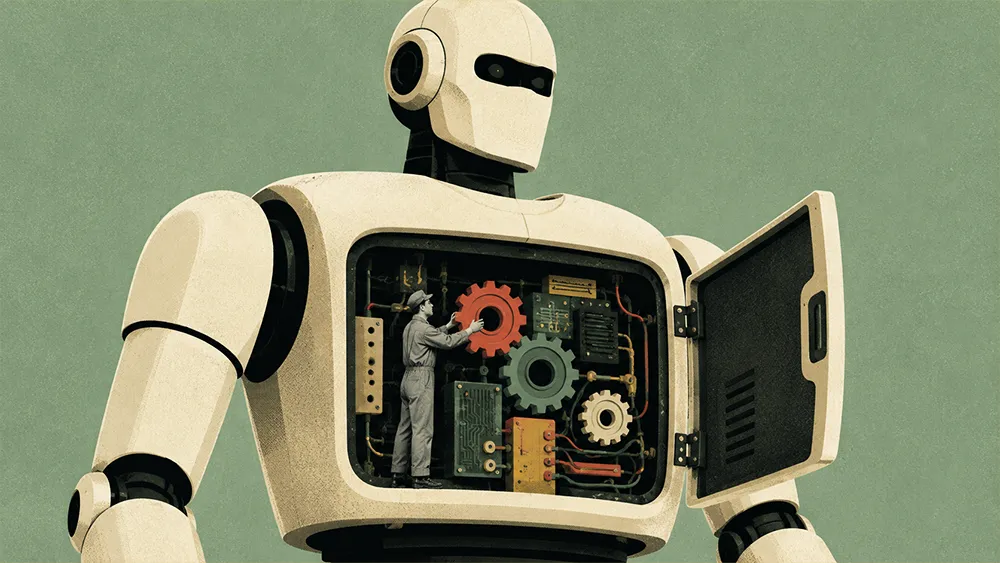
AI sitting in on our meetings, looking at our Slacks and our emails, can provide workers with real-time feedback on their performance and how they can get better.

Matt Troskey
Founder
Troskey Fractional HR & Consulting
Performance management has been cycling through reinvention for decades without ever settling the foundational question of what exactly the employer is trying to improve. From military-era promotion rankings to Jack Welch’s rank-and-yank era to the current wave of continuous-feedback tools, each iteration has tried to solve a problem that most organizations have never clearly defined. Until that question is answered with precision, the system built around it will always underdeliver, regardless of how much technology is layered on top.
Matt Troskey has spent more than two decades navigating this operational hurdle. He’s the Founder of Troskey Fractional HR & Consulting, which helps organizations bring strategy and consistency to their people operations. With a background grounded in organizational development, his approach to performance management starts by stripping away the inherited system and asking what the organization is actually trying to achieve through its people. He’s a firm believer that with the proper infrastructure in place, AI can be a powerful asset here.
“AI sitting in on our meetings, looking at our Slacks and our emails, can provide workers with real-time feedback on their performance and how they can get better,” Troskey says. He emphasizes that this capability only creates value when the inputs guiding it, like the job description, strategic plan, and cultural norms, have been built with enough clarity and intention to make the feedback meaningful.
Daily coaching over annual reviews
Rather than evaluation at scale, the promise Troskey sees in AI-driven performance management is incremental, real-time coaching that compounds over time. Instead of a manager collecting observations for months and delivering them in a formal review, where the volume of feedback overwhelms the employee and nothing feels actionable, AI can surface one or two focused improvements at a time. “Instead of somebody coming to you with feedback and they gunny-sack all of this stuff on you, AI gives you the ability to say, ‘Give me the top thing I should be working on today.’ Every day, I’m working on getting incrementally better. That is what actually grows the person,” he explains.
The neutrality matters too. Feedback from a manager carries the relational weight of power dynamics, interpersonal history, and perceived motives. AI delivers the same observation without those layers. “A lot of us would take feedback better from an agent because it’s absolutely neutral,” Troskey says. “It feels more like a coach who’s in my corner to help me get better.”
He’s clear that this doesn’t eliminate the need for human feedback. The relationships between managers and employees remain one of the highest-value elements of the workplace. But AI handles the volume and frequency that humans can’t sustain, freeing managers to focus on the conversations that require trust, context, and emotional intelligence.
Three inputs HR must own
Before AI can evaluate or coach effectively, it needs the right inputs. Troskey identifies three that HR is uniquely responsible for building and maintaining.
The first is a job description tied to the role’s actual business purpose. This shouldn’t be a generic list of responsibilities, but a clear articulation of what this role is expected to produce and how that output connects to the organization’s results. “The ability to start with a job description that’s well appointed at the business results we’re trying to achieve is a huge part of it,” Troskey advises.
The second is the organization’s strategic plan. Every individual’s work should flow upward, at a tactical level, into the company’s broader goals and vision. Without that connection, he says, AI has no way to assess whether an employee’s daily activities are aligned with what the business needs. “Every person in the organization should be able to point at what they’re doing and it should feed up to the strategic plan.”
The third is cultural norms. These go beyond values posters and mission statements and include how the organization defines acceptable behavior, how it prioritizes competing values, and what it will and won’t tolerate. Troskey shares a concrete example from a department that processed payroll. One cultural norm was that anything going to a large audience required a second set of eyes. That level of specificity matters because it gives AI a standard to coach against.
He raises a more consequential example around values prioritization. If an organization lists both safety and service as core values but doesn’t explicitly state that safety always supersedes service, an AI system might praise a decision that prioritized customer service while creating a safety risk. “Those things are the kind of things a lot of organizations don’t specify,” Troskey notes. “You have to direct AI to understand that hierarchy.”
Revisiting the inputs frequently
Troskey’s strongest caution is that AI-powered performance management is not a set-and-forget system. The inputs must be revisited continuously. If a manager reports that the feedback doesn’t seem right, or business results don’t improve despite strong coaching scores, HR needs to investigate whether the prompts, the job design, or the cultural definitions are flawed. “HR has to be able to take feedback and go, ‘That didn’t work for this person,’ or, ‘This manager is seeing something that’s amiss,'” he says. “Do we need to go back and look at our inputs? Do we need to change the job description? Do we need to clarify what those cultural norms are?”
He points out one final requirement for mastering AI-powered performance management: using the time AI freed up to invest in the relationships and human judgment that no system can replicate. “We should still be thinking as humans how to increase the humanity in the workplace and how AI can assist us in growing our relationships,” Troskey says. “That can happen once we’ve now offboarded some of the more trivial or messier things to AI.”
Related articles



TL;DR
Traditional performance management has cycled through reinvention for decades without clearly defining what it’s trying to improve, and layering AI onto an undefined system produces the same dysfunction at faster speed.
Matt Troskey, Founder of Troskey Fractional HR & Consulting, asserts that AI can deliver real-time, neutral coaching that compounds daily, but only when HR provides the foundational inputs.
He says HR teams that continuously revisit and audit the inputs behind AI-powered performance systems will build organizations where AI strengthens accountability and relationships rather than automating a flawed culture.

Matt Troskey
Troskey Fractional HR & Consulting
Founder
Founder
Performance management has been cycling through reinvention for decades without ever settling the foundational question of what exactly the employer is trying to improve. From military-era promotion rankings to Jack Welch’s rank-and-yank era to the current wave of continuous-feedback tools, each iteration has tried to solve a problem that most organizations have never clearly defined. Until that question is answered with precision, the system built around it will always underdeliver, regardless of how much technology is layered on top.
Matt Troskey has spent more than two decades navigating this operational hurdle. He’s the Founder of Troskey Fractional HR & Consulting, which helps organizations bring strategy and consistency to their people operations. With a background grounded in organizational development, his approach to performance management starts by stripping away the inherited system and asking what the organization is actually trying to achieve through its people. He’s a firm believer that with the proper infrastructure in place, AI can be a powerful asset here.
“AI sitting in on our meetings, looking at our Slacks and our emails, can provide workers with real-time feedback on their performance and how they can get better,” Troskey says. He emphasizes that this capability only creates value when the inputs guiding it, like the job description, strategic plan, and cultural norms, have been built with enough clarity and intention to make the feedback meaningful.
Daily coaching over annual reviews
Rather than evaluation at scale, the promise Troskey sees in AI-driven performance management is incremental, real-time coaching that compounds over time. Instead of a manager collecting observations for months and delivering them in a formal review, where the volume of feedback overwhelms the employee and nothing feels actionable, AI can surface one or two focused improvements at a time. “Instead of somebody coming to you with feedback and they gunny-sack all of this stuff on you, AI gives you the ability to say, ‘Give me the top thing I should be working on today.’ Every day, I’m working on getting incrementally better. That is what actually grows the person,” he explains.
The neutrality matters too. Feedback from a manager carries the relational weight of power dynamics, interpersonal history, and perceived motives. AI delivers the same observation without those layers. “A lot of us would take feedback better from an agent because it’s absolutely neutral,” Troskey says. “It feels more like a coach who’s in my corner to help me get better.”
He’s clear that this doesn’t eliminate the need for human feedback. The relationships between managers and employees remain one of the highest-value elements of the workplace. But AI handles the volume and frequency that humans can’t sustain, freeing managers to focus on the conversations that require trust, context, and emotional intelligence.
Three inputs HR must own
Before AI can evaluate or coach effectively, it needs the right inputs. Troskey identifies three that HR is uniquely responsible for building and maintaining.
The first is a job description tied to the role’s actual business purpose. This shouldn’t be a generic list of responsibilities, but a clear articulation of what this role is expected to produce and how that output connects to the organization’s results. “The ability to start with a job description that’s well appointed at the business results we’re trying to achieve is a huge part of it,” Troskey advises.
The second is the organization’s strategic plan. Every individual’s work should flow upward, at a tactical level, into the company’s broader goals and vision. Without that connection, he says, AI has no way to assess whether an employee’s daily activities are aligned with what the business needs. “Every person in the organization should be able to point at what they’re doing and it should feed up to the strategic plan.”
The third is cultural norms. These go beyond values posters and mission statements and include how the organization defines acceptable behavior, how it prioritizes competing values, and what it will and won’t tolerate. Troskey shares a concrete example from a department that processed payroll. One cultural norm was that anything going to a large audience required a second set of eyes. That level of specificity matters because it gives AI a standard to coach against.
He raises a more consequential example around values prioritization. If an organization lists both safety and service as core values but doesn’t explicitly state that safety always supersedes service, an AI system might praise a decision that prioritized customer service while creating a safety risk. “Those things are the kind of things a lot of organizations don’t specify,” Troskey notes. “You have to direct AI to understand that hierarchy.”
Revisiting the inputs frequently
Troskey’s strongest caution is that AI-powered performance management is not a set-and-forget system. The inputs must be revisited continuously. If a manager reports that the feedback doesn’t seem right, or business results don’t improve despite strong coaching scores, HR needs to investigate whether the prompts, the job design, or the cultural definitions are flawed. “HR has to be able to take feedback and go, ‘That didn’t work for this person,’ or, ‘This manager is seeing something that’s amiss,'” he says. “Do we need to go back and look at our inputs? Do we need to change the job description? Do we need to clarify what those cultural norms are?”
He points out one final requirement for mastering AI-powered performance management: using the time AI freed up to invest in the relationships and human judgment that no system can replicate. “We should still be thinking as humans how to increase the humanity in the workplace and how AI can assist us in growing our relationships,” Troskey says. “That can happen once we’ve now offboarded some of the more trivial or messier things to AI.”