
AI Evolves From Threat to Evaluation Target As Interview Design Plays Catch-Up
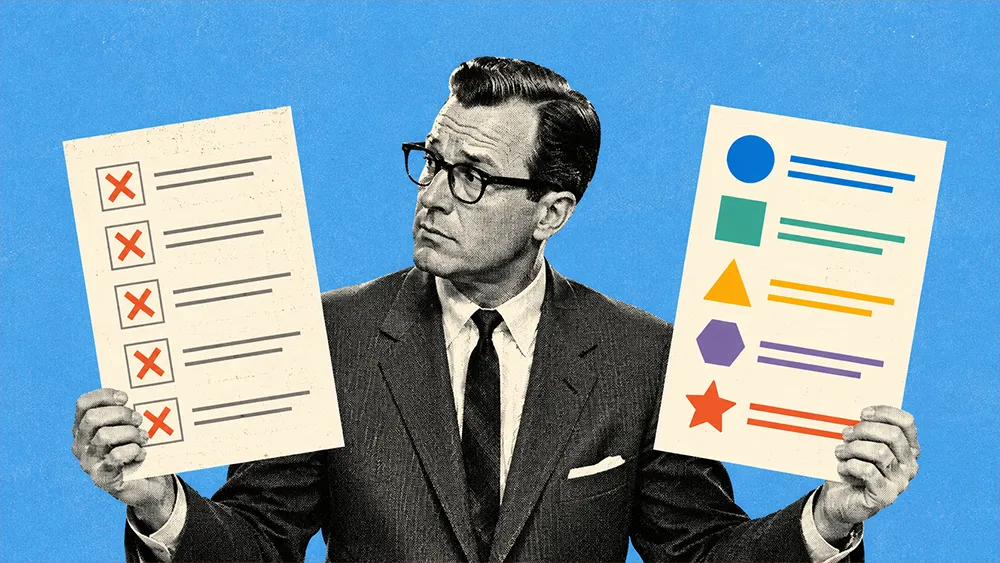
Down the road, HR is going to want to know how well you collaborate with AI to make your productivity better, more effective, and more time-efficient.

Cynthia Gutierrez-White
Author and Communications Strategist
Hiring teams are still building interview steps that treat AI as something to keep out of the room. The clearest sign is the disclaimer now appearing on take-home assignments across knowledge work: “do not use AI.” That posture has a short shelf life. As AI becomes embedded in how every knowledge worker actually does the job, the interview questions worth asking surround how they think, what tools they choose, how they prompt, how they verify what comes back, and how they apply professional judgment when the output is wrong.
Cynthia Gutierrez-White is an award-winning Author and Communications Strategist with more than two decades of experience leading media relations and corporate comms across healthcare, disaster response, and national crisis events. She has held senior roles at organizations like Johns Hopkins Medicine, Nicklaus Children’s Hospital, and the American Red Cross, where she served as a national spokesperson. Her new book grew out of her own 2025 job search, during which the playbook that had served her for years collapsed under a market reshaped by AI. In her view, the most forward-thinking organizations are shedding hiring systems built for the past.
“Down the road, HR is going to want to know how well you collaborate with AI to make your productivity better, more effective, and more time-efficient,” she says. That perspective reframes AI’s place in the interview so that the conversation stops being about whether the candidate used it, and starts focusing on how.
The do-not-use signal
The clearest evidence that an organization’s interview design has not caught up is the disclaimer itself. Gutierrez-White encountered it on a recent communications assignment that asked her to build a multichannel campaign across internal communications, press, social, and web in two hours. “From an HR perspective, they want to see if this person can think on their feet. They want to know if they have that industry knowledge of how to handle certain situations.” The intent, she acknowledges, is reasonable. Hiring teams want to assess whether the candidate has the underlying judgment to handle the work. The mechanism, asking candidates to perform without the tools they would actually use on the job, tests for an artificial version of the role. It also creates an ethical mismatch in the interview itself, because no employer can actually verify whether the prohibition was honored.
Judgment is the new evaluation target
Gutierrez-White’s read of where serious interview design is heading involves giving candidates difficult or near-impossible scenarios and asking them to use AI as a collaborator. The evaluation shifts to the candidate’s reasoning process, including which tools they reach for, how they structure the problem, and how they direct the output. “It’s no longer the case of saying, well, I’ll use an AI agent to help me do X, Y, and Z. We now have platforms where you’re orchestrating a team of different agents, each one with a specific task, agents reporting to other agents. They want to know if you think that way.”
The capability she describes is closer to judgment than to prompting. It requires understanding which problems benefit from AI assistance, which require human-only thinking, where AI tends to fail, and how to verify output that looks confident but is wrong. Those are evaluable skills. They’re also harder to fake under interview conditions, because the candidate has to talk through the reasoning in real time. “They want to see if you can use the appropriate tools so that you become a powerhouse with your education, experience, wisdom, and know-how coupled with AI,” she says.
What good looks like
The practical risk for HR teams is that scenario-based AI assessments reward the wrong signals. Gutierrez-White is clear that the human core matters more, not less, in this design. “The people who stand out are the ones who can translate their work into real-world outcomes,” she asserts. “Applicants have got to talk about impact instead of tasks.” Outcomes thinking is not something AI can fake on the candidate’s behalf. A candidate who can describe what changed because of their work, with numbers, context, and a clear chain of cause and effect, signals the judgment HR teams are trying to identify. That signal carries through whether the conversation is about a past role, a take-home exercise, or an AI-assisted scenario.
The HR opportunity
Growing companies cannot afford to filter out candidates whose strongest skill is exactly the one the role increasingly requires. They also can’t afford to hire candidates whose only skill is producing AI output without the judgment to evaluate it. In Gutierrez-White’s perspective, the organizations that will hire well over the next few years will be the ones that start treating AI as something worthy of evaluating, sharpening their focus on candidates who combine human experience, ethical judgment, and AI-enabled problem-solving. She sees it as indicative of a broader shift underway in the job market. “The job search has shifted from volume to precision, but people haven’t caught up yet,” she says. “Things are changing quickly, and it will take time to adapt.”
Related articles


TL;DR
The common HR tactic of asking candidates not to use AI during sample assignments tests for a version of the role that no longer exists.
Cynthia Gutierrez-White, award-winning Author and Communications Strategist, asserts that interview design should evolve to evaluate judgment, tool selection, and AI collaboration as core capabilities.
She believes the hiring advantage is shifting toward scenario-based assessments that test how candidates structure problems, verify output, and translate work into outcomes.

Cynthia Gutierrez-White
Author and Communications Strategist
Author and Communications Strategist
Hiring teams are still building interview steps that treat AI as something to keep out of the room. The clearest sign is the disclaimer now appearing on take-home assignments across knowledge work: “do not use AI.” That posture has a short shelf life. As AI becomes embedded in how every knowledge worker actually does the job, the interview questions worth asking surround how they think, what tools they choose, how they prompt, how they verify what comes back, and how they apply professional judgment when the output is wrong.
Cynthia Gutierrez-White is an award-winning Author and Communications Strategist with more than two decades of experience leading media relations and corporate comms across healthcare, disaster response, and national crisis events. She has held senior roles at organizations like Johns Hopkins Medicine, Nicklaus Children’s Hospital, and the American Red Cross, where she served as a national spokesperson. Her new book grew out of her own 2025 job search, during which the playbook that had served her for years collapsed under a market reshaped by AI. In her view, the most forward-thinking organizations are shedding hiring systems built for the past.
“Down the road, HR is going to want to know how well you collaborate with AI to make your productivity better, more effective, and more time-efficient,” she says. That perspective reframes AI’s place in the interview so that the conversation stops being about whether the candidate used it, and starts focusing on how.
The do-not-use signal
The clearest evidence that an organization’s interview design has not caught up is the disclaimer itself. Gutierrez-White encountered it on a recent communications assignment that asked her to build a multichannel campaign across internal communications, press, social, and web in two hours. “From an HR perspective, they want to see if this person can think on their feet. They want to know if they have that industry knowledge of how to handle certain situations.” The intent, she acknowledges, is reasonable. Hiring teams want to assess whether the candidate has the underlying judgment to handle the work. The mechanism, asking candidates to perform without the tools they would actually use on the job, tests for an artificial version of the role. It also creates an ethical mismatch in the interview itself, because no employer can actually verify whether the prohibition was honored.
Judgment is the new evaluation target
Gutierrez-White’s read of where serious interview design is heading involves giving candidates difficult or near-impossible scenarios and asking them to use AI as a collaborator. The evaluation shifts to the candidate’s reasoning process, including which tools they reach for, how they structure the problem, and how they direct the output. “It’s no longer the case of saying, well, I’ll use an AI agent to help me do X, Y, and Z. We now have platforms where you’re orchestrating a team of different agents, each one with a specific task, agents reporting to other agents. They want to know if you think that way.”
The capability she describes is closer to judgment than to prompting. It requires understanding which problems benefit from AI assistance, which require human-only thinking, where AI tends to fail, and how to verify output that looks confident but is wrong. Those are evaluable skills. They’re also harder to fake under interview conditions, because the candidate has to talk through the reasoning in real time. “They want to see if you can use the appropriate tools so that you become a powerhouse with your education, experience, wisdom, and know-how coupled with AI,” she says.
What good looks like
The practical risk for HR teams is that scenario-based AI assessments reward the wrong signals. Gutierrez-White is clear that the human core matters more, not less, in this design. “The people who stand out are the ones who can translate their work into real-world outcomes,” she asserts. “Applicants have got to talk about impact instead of tasks.” Outcomes thinking is not something AI can fake on the candidate’s behalf. A candidate who can describe what changed because of their work, with numbers, context, and a clear chain of cause and effect, signals the judgment HR teams are trying to identify. That signal carries through whether the conversation is about a past role, a take-home exercise, or an AI-assisted scenario.
The HR opportunity
Growing companies cannot afford to filter out candidates whose strongest skill is exactly the one the role increasingly requires. They also can’t afford to hire candidates whose only skill is producing AI output without the judgment to evaluate it. In Gutierrez-White’s perspective, the organizations that will hire well over the next few years will be the ones that start treating AI as something worthy of evaluating, sharpening their focus on candidates who combine human experience, ethical judgment, and AI-enabled problem-solving. She sees it as indicative of a broader shift underway in the job market. “The job search has shifted from volume to precision, but people haven’t caught up yet,” she says. “Things are changing quickly, and it will take time to adapt.”