
How the University of New Haven Aligns Industry and Education to Prepare AI-Ready Graduates
"At minimum, we need to be at pace with the speed of relevance. Ideally, we want to be a step ahead of it."

Paul Lavoie
VP, Innovation & Applied Technology
University of New Haven
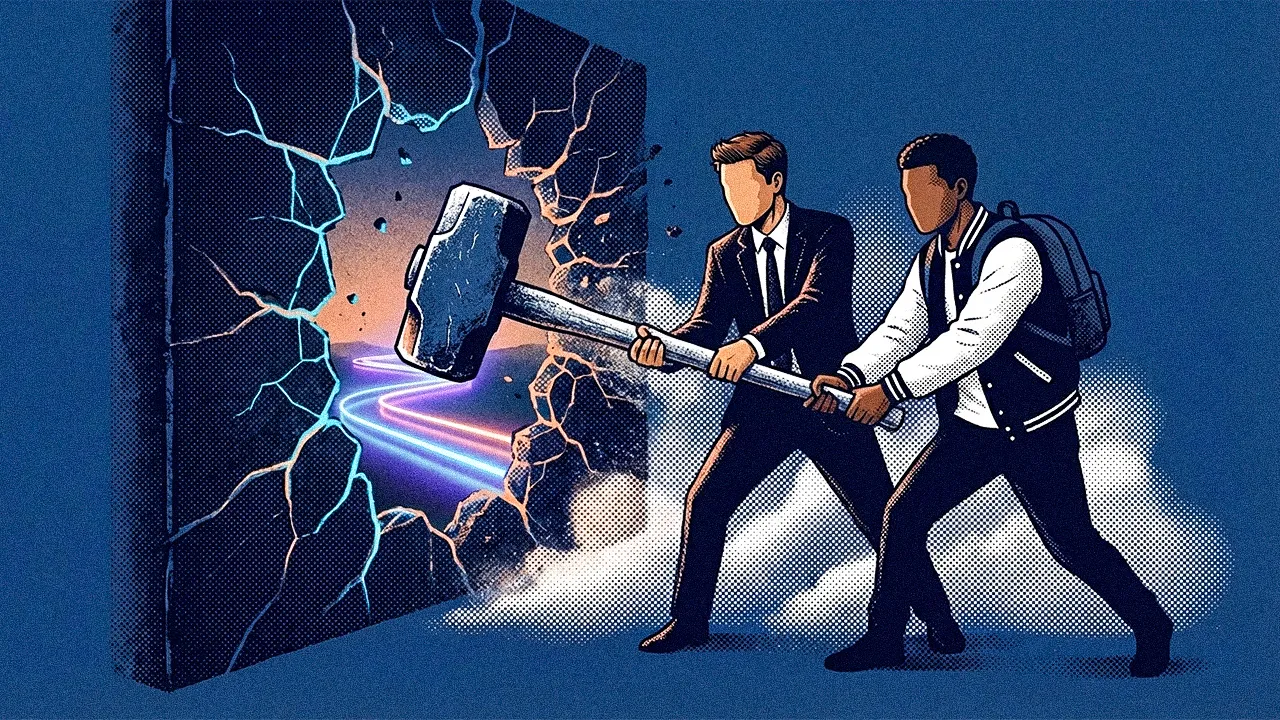
The University of New Haven has reorganized its leadership so one office owns the full pipeline from industry engagement to career launch, collapsing the traditional divide between campus and industry. Corporate partnerships, applied research, experiential learning, and career advising now operate under a single strategy that brings employers directly into how students learn and work. Seven months in, the model is already producing results, including six signed master research agreements, students building AI applications for Connecticut companies, and hands-on projects ranging from tariff mitigation workshops to shop-floor optimization.
Paul Lavoie is the Vice President of Innovation and Applied Technology at the University of New Haven. He previously served as Connecticut’s Chief Manufacturing Officer and was named one of the top five Chief Manufacturing Officers globally by Manufacturing Digital Magazine. At the university, he oversees a 130,000-square-foot Research and Development Park focused on advanced manufacturing, cybersecurity, robotics, and biotech, with data platform infrastructure central to the applied research agenda.
“I’m not afraid of change. I’m afraid of staying the same. I started my career with typewriters and have lived through the computer revolution, the internet revolution, the smartphone revolution, automation, and now AI. The only constant skill you can rely on is adaptability and a relentless quest to keep learning,” Lavoie says. The model works by treating industry partners as co-designers of the student experience. Faculty get direct input from employers so curriculum stays informed by where industries are heading, not where they were when the syllabus was written. Companies get access to students who function as an extension of their workforce on projects they lack the resources to complete internally.
Beyond just in case: “Most universities are built on the ‘just in case’ model of education: we teach you a bunch of stuff just in case you might need it when you graduate. That doesn’t lead to a return on investment for students or their families,” Lavoie says. The university instead anchors every program to three pillars: industry-informed curriculum, real experiential learning, and what it calls the Charger 11, a set of durable skills like critical decision-making, communication, and problem-solving that employers consistently say graduates lack.
Students as workforce: “We reach out to industry and say, we’re an extension of your workforce for the things you don’t have the capacity to get done,” Lavoie says. That includes students working on robotics and automation projects, building custom AI tools for regional companies, and running workshops on tariff mitigation strategy with business faculty. “Their engineers are busy making parts. They have all these improvement projects they want to do and don’t have the resources. We do.”
The speed at which technical skills depreciate is reshaping how Lavoie thinks about degree programs. He estimates that a skill learned today has roughly eighteen months of relevance, down from ten years earlier in his career. That compression means universities may need to reskill students while they are still enrolled.
Perishable skills: “If we do a bachelor’s degree in artificial intelligence, is that degree relevant upon graduation with the speed that AI is moving? We’ve probably given you an amazing foundation, but your learning is just beginning at that point,” Lavoie says. He describes the challenge as innovating at the speed of relevancy while that speed accelerates. “At minimum, we need to be at pace with the speed of relevance. Ideally, we want to be a step ahead of it.”
Credentials that stack: The university is building microcredentials, certificates, and stackable credentials that employers can use to upskill teams without a full degree commitment. “We want to be an extension of corporations’ training departments. A small company might send one person for a cybersecurity credential. A larger one might send twenty and want us to come to them. We’re happy to do either,” Lavoie says.
Internally, the university is applying the same logic to its own operations. Lavoie is leading an AI literacy initiative that starts with the president’s cabinet going through Microsoft’s AI certification program before extending to deans, faculty, and department heads. The approach mirrors what enterprise leaders are finding: governance and adoption start at the top.
In parallel, the university has launched a campus-wide software inventory to catalog every application, its functionality, cost, and contract terms, with Lavoie expecting to find 50% savings. The logic is straightforward: a university that asks industry to adopt AI needs to demonstrate that it can build and deploy those tools itself. As organizations rewire around AI, the institutions training the next generation of workers face the same transformation pressure.
“You can’t have AI literacy throughout the university if leadership isn’t AI literate first,” Lavoie says. “Right now, it’s all over the board. We have high adopters and we have people who have no idea what Copilot is. We have to level-set the entire university before we can move forward.”
Related articles




TL;DR
The University of New Haven has consolidated corporate partnerships, research collaborations, internships, and career development under one role, creating a direct line between employer needs and student preparation.
Paul Lavoie, Vice President of Innovation and Applied Technology at the University of New Haven, says the traditional “just in case” model of higher education no longer delivers return on investment for students or employers.
The university is building microcredentials, stackable certificates, and an AI literacy framework that starts with executive leadership and extends across every department.

Paul Lavoie
University of New Haven
VP, Innovation & Applied Technology
VP, Innovation & Applied Technology
The University of New Haven has reorganized its leadership so one office owns the full pipeline from industry engagement to career launch, collapsing the traditional divide between campus and industry. Corporate partnerships, applied research, experiential learning, and career advising now operate under a single strategy that brings employers directly into how students learn and work. Seven months in, the model is already producing results, including six signed master research agreements, students building AI applications for Connecticut companies, and hands-on projects ranging from tariff mitigation workshops to shop-floor optimization.
Paul Lavoie is the Vice President of Innovation and Applied Technology at the University of New Haven. He previously served as Connecticut’s Chief Manufacturing Officer and was named one of the top five Chief Manufacturing Officers globally by Manufacturing Digital Magazine. At the university, he oversees a 130,000-square-foot Research and Development Park focused on advanced manufacturing, cybersecurity, robotics, and biotech, with data platform infrastructure central to the applied research agenda.
“I’m not afraid of change. I’m afraid of staying the same. I started my career with typewriters and have lived through the computer revolution, the internet revolution, the smartphone revolution, automation, and now AI. The only constant skill you can rely on is adaptability and a relentless quest to keep learning,” Lavoie says. The model works by treating industry partners as co-designers of the student experience. Faculty get direct input from employers so curriculum stays informed by where industries are heading, not where they were when the syllabus was written. Companies get access to students who function as an extension of their workforce on projects they lack the resources to complete internally.
Beyond just in case: “Most universities are built on the ‘just in case’ model of education: we teach you a bunch of stuff just in case you might need it when you graduate. That doesn’t lead to a return on investment for students or their families,” Lavoie says. The university instead anchors every program to three pillars: industry-informed curriculum, real experiential learning, and what it calls the Charger 11, a set of durable skills like critical decision-making, communication, and problem-solving that employers consistently say graduates lack.
Students as workforce: “We reach out to industry and say, we’re an extension of your workforce for the things you don’t have the capacity to get done,” Lavoie says. That includes students working on robotics and automation projects, building custom AI tools for regional companies, and running workshops on tariff mitigation strategy with business faculty. “Their engineers are busy making parts. They have all these improvement projects they want to do and don’t have the resources. We do.”
The speed at which technical skills depreciate is reshaping how Lavoie thinks about degree programs. He estimates that a skill learned today has roughly eighteen months of relevance, down from ten years earlier in his career. That compression means universities may need to reskill students while they are still enrolled.
Perishable skills: “If we do a bachelor’s degree in artificial intelligence, is that degree relevant upon graduation with the speed that AI is moving? We’ve probably given you an amazing foundation, but your learning is just beginning at that point,” Lavoie says. He describes the challenge as innovating at the speed of relevancy while that speed accelerates. “At minimum, we need to be at pace with the speed of relevance. Ideally, we want to be a step ahead of it.”
Credentials that stack: The university is building microcredentials, certificates, and stackable credentials that employers can use to upskill teams without a full degree commitment. “We want to be an extension of corporations’ training departments. A small company might send one person for a cybersecurity credential. A larger one might send twenty and want us to come to them. We’re happy to do either,” Lavoie says.
Internally, the university is applying the same logic to its own operations. Lavoie is leading an AI literacy initiative that starts with the president’s cabinet going through Microsoft’s AI certification program before extending to deans, faculty, and department heads. The approach mirrors what enterprise leaders are finding: governance and adoption start at the top.
In parallel, the university has launched a campus-wide software inventory to catalog every application, its functionality, cost, and contract terms, with Lavoie expecting to find 50% savings. The logic is straightforward: a university that asks industry to adopt AI needs to demonstrate that it can build and deploy those tools itself. As organizations rewire around AI, the institutions training the next generation of workers face the same transformation pressure.
“You can’t have AI literacy throughout the university if leadership isn’t AI literate first,” Lavoie says. “Right now, it’s all over the board. We have high adopters and we have people who have no idea what Copilot is. We have to level-set the entire university before we can move forward.”