
The Hidden Cost Of Automating The Apprenticeship Pipeline
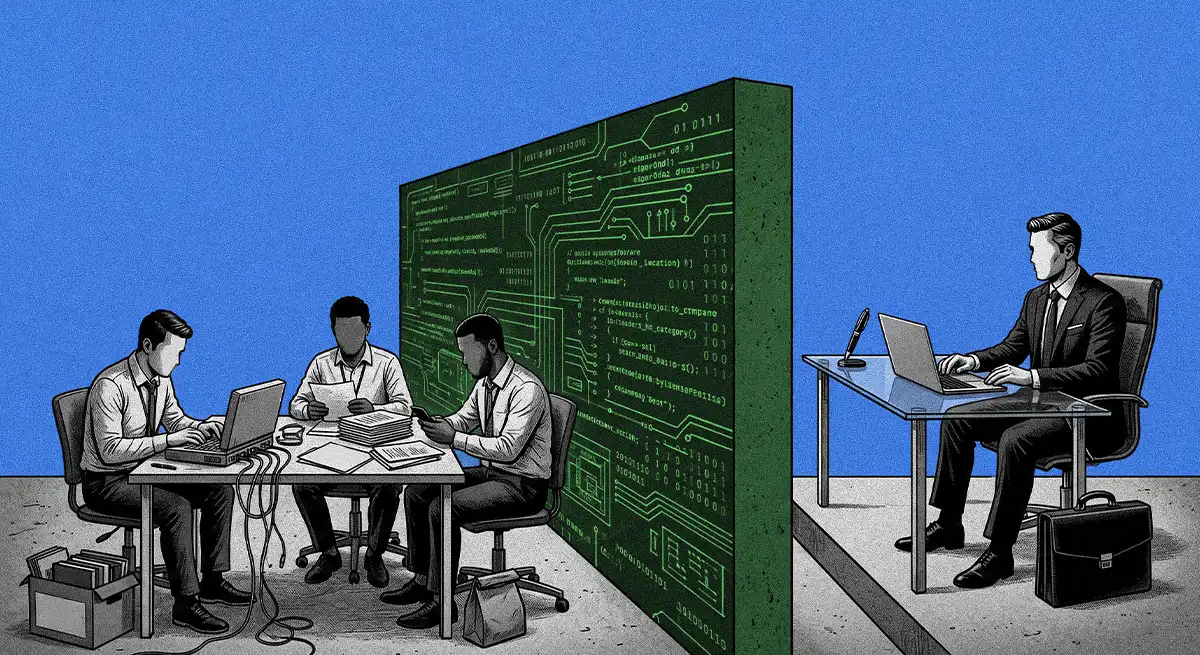
AI replicates codified knowledge. Apprenticeship transmits judgment. The solution is making sure that you respect the enduring value of apprenticeship as a means to transmit judgment over time.

Paul Roebuck
Independent Advisor
Former Global Client Lead for Colgate-Palmolive, WPP
The corporate push for AI efficiency is creating a critical blind spot inside the talent pipeline. As enterprises chase short-term productivity gains, the software is being deployed in the exact place it can most credibly match human output: the entry-level layer. Using AI to replace entry-level jobs is changing the nature of early-career work and risking a future leadership crisis in ways that don’t yet show up on the org chart. Overall headcounts may look stable, but the makeup of the workforce is changing fast. Automating junior roles for immediate cost savings often eliminates the exposure future leaders need to learn the unwritten realities of corporate decision-making, with the real casualty being the simple act of being in the room.
Paul Roebuck has spent nearly 30 years watching how enterprise pipelines actually get built. He held C-suite and EVP roles across global advertising giants WPP and Omnicom, managing global client leadership for Fortune 500 accounts including Johnson & Johnson, Colgate-Palmolive, and Ford Motor Company. He now runs an independent advisory practice in New York, working with CEOs on redesigning operating models for the AI era. From that vantage point, Roebuck sees an overlooked consequence of enterprise AI: the slow erosion of the apprenticeship model.
“AI replicates codified knowledge. Apprenticeship transmits judgment. The solution is making sure that you respect the enduring value of apprenticeship as a means to transmit judgment over time,” says Roebuck. The distinction reveals a fundamental difference in how AI and humans actually develop capability. Industry leaders prioritizing technological task execution often skip past the human context mining that happens inside formal mentorship programs, where junior employees absorb the layered judgment that no system can write down. The oversight is reinforcing ongoing skepticism around AI’s ability to exercise judgment and surfacing a strategic question companies will need to answer: what happens when the next generation of senior leaders never had the chance to learn what cannot be coded?
The copilot paradox
Roebuck draws a clean line between training and apprenticeship. Training is the transfer of written instructions, the codified material a manual or onboarding deck can capture. Apprenticeship operates on a different axis altogether, transferring unwritten, tacit knowledge through physical proximity to senior decision-makers. Junior employees absorb human judgment simply by sitting in a meeting and observing the nuanced realities of executive alignment, picking up patterns that no orientation program could teach them. “Apprenticeship is about pattern recognition. It is understanding why deals die, or hearing what is said in the room but isn’t said in the meeting afterward,” Roebuck says. “If you don’t have junior people in the room doing the listening and watching, you simply aren’t creating the next generation of leaders.”
The gap between human and machine learning surfaces a literal irony in modern enterprise software, since the same AI tools replacing entry-level roles are often marketed as “copilots”. A true human copilot, though, absorbs layered situational judgment through years of physical proximity on the flight deck, the same kind of exposure junior employees lose when their roles disappear. Junior staff are not only the pipeline for future leaders, but also the workforce capable of auditing AI outputs against real-world judgment. “If you rely entirely on automation, you create a very real risk. If you aren’t producing people who understand how to take control of the plane when the automation fails, lives are lost,” Roebuck notes, translating the aviation analogy to corporate governance. “Even if AI does get there, you’re still going to need humans who have the judgment to understand whether what AI is answering is the right answer. You cannot oversee what you don’t understand.”
Boardroom blind spot
The hiring realignment hides behind aggregate employment numbers, with HR positioned as the only function watching entry-level hiring ratios while corporate boards see overall headcount and conclude everything is fine. Findings from BambooHR’s State of the Workforce 2026 report, The Rising Cost of Dignity Debt, make a similar point on a wider scale, calling on companies to rebuild talent strategy, reimagine entry-level pathways, and reinvest in mentorship. With that kind of evidence in hand, HR leaders can act as internal translators, turning raw hiring data into a tangible business risk the executive team can understand. “This is an institutional architecture problem that expresses itself first in hiring numbers, which means HR will see it first. HR can interpret what the data actually means before the board sees it in another way,” Roebuck says. “HR can argue for the pipeline against short-term productivity gains. HR can name it, but HR can’t necessarily decide it. And that’s the responsibility the function has to the organization.”
Pitching a decade-long pipeline is a tough sell when modern employees frequently leave after a couple of years, especially as employers face widespread Gen Z career chaos, changing expectations around workplace wellbeing, and spikes in youth unemployment. Some organizations are treating AI as a stable career accelerator for entry-level talent, while others, like Bank of America, are actively hiring campus recruits despite the AI threat. For Roebuck, the path forward involves reframing apprenticeship from an isolated enterprise expense into an industry-wide ecosystem, since the leadership pipeline only stays viable when companies rethinking entry-level hiring in the AI era build talent collectively. “There needs to be a recognition on the part of enterprises that you need to invest in the next generation of talent in your industry. And there is some trade-off with that because it’s an open marketplace,” Roebuck says. “I’ve been a beneficiary of apprenticeship and mentorship through my career, and that has made me an asset to whichever enterprise I end up working for.”
Playing the apprenticeship long game
Leadership teams chasing new AI capabilities often miss a simpler solution: keeping junior employees present during client meetings, negotiations, and leadership alignments. Companies focused on what AI changes risk losing sight of the human development mechanisms that stay the same. “Specific functional tasks may change shape because the tools you use are different. But the judgment you deploy is still tacit in the individual and still can only be learned through watching and observing,” Roebuck says. “Right now, the narrative of the industry is enamored with the technology because it’s exciting, but what people aren’t talking about is what doesn’t change. The risk right now is that most people are looking for efficiency in that junior layer. You don’t know what you are doing if you completely hollow that out.”
The longer view should give every HR leader pause, since the consequences of underinvesting in apprenticeship now will compound over the kind of timeline most boards rarely plan for. “Effectively, industries are stopping the production of the next generation of talent. The danger is that it will be 10 years before anybody actually realizes what they’ve done. It may feel like a gain now, but it is going to be a problem in 10 years because there will be no market for senior capability. You simply forgot to create that talent,” Roebuck says. Even the strongest AI deployment cannot solve the problem on its own, which loops back to the original argument about who absorbs judgment and how. “The reality is that we aren’t going to be replaced by machines. Talent is still human,” Roebuck concludes. “In that environment, you’ve got to make sure that in 10 years you still have a defensible position in the marketplace.”
Related articles




TL;DR

Paul Roebuck
Former Global Client Lead for Colgate-Palmolive, WPP
Independent Advisor
Independent Advisor
The corporate push for AI efficiency is creating a critical blind spot inside the talent pipeline. As enterprises chase short-term productivity gains, the software is being deployed in the exact place it can most credibly match human output: the entry-level layer. Using AI to replace entry-level jobs is changing the nature of early-career work and risking a future leadership crisis in ways that don’t yet show up on the org chart. Overall headcounts may look stable, but the makeup of the workforce is changing fast. Automating junior roles for immediate cost savings often eliminates the exposure future leaders need to learn the unwritten realities of corporate decision-making, with the real casualty being the simple act of being in the room.
Paul Roebuck has spent nearly 30 years watching how enterprise pipelines actually get built. He held C-suite and EVP roles across global advertising giants WPP and Omnicom, managing global client leadership for Fortune 500 accounts including Johnson & Johnson, Colgate-Palmolive, and Ford Motor Company. He now runs an independent advisory practice in New York, working with CEOs on redesigning operating models for the AI era. From that vantage point, Roebuck sees an overlooked consequence of enterprise AI: the slow erosion of the apprenticeship model.
“AI replicates codified knowledge. Apprenticeship transmits judgment. The solution is making sure that you respect the enduring value of apprenticeship as a means to transmit judgment over time,” says Roebuck. The distinction reveals a fundamental difference in how AI and humans actually develop capability. Industry leaders prioritizing technological task execution often skip past the human context mining that happens inside formal mentorship programs, where junior employees absorb the layered judgment that no system can write down. The oversight is reinforcing ongoing skepticism around AI’s ability to exercise judgment and surfacing a strategic question companies will need to answer: what happens when the next generation of senior leaders never had the chance to learn what cannot be coded?
The copilot paradox
Roebuck draws a clean line between training and apprenticeship. Training is the transfer of written instructions, the codified material a manual or onboarding deck can capture. Apprenticeship operates on a different axis altogether, transferring unwritten, tacit knowledge through physical proximity to senior decision-makers. Junior employees absorb human judgment simply by sitting in a meeting and observing the nuanced realities of executive alignment, picking up patterns that no orientation program could teach them. “Apprenticeship is about pattern recognition. It is understanding why deals die, or hearing what is said in the room but isn’t said in the meeting afterward,” Roebuck says. “If you don’t have junior people in the room doing the listening and watching, you simply aren’t creating the next generation of leaders.”
The gap between human and machine learning surfaces a literal irony in modern enterprise software, since the same AI tools replacing entry-level roles are often marketed as “copilots”. A true human copilot, though, absorbs layered situational judgment through years of physical proximity on the flight deck, the same kind of exposure junior employees lose when their roles disappear. Junior staff are not only the pipeline for future leaders, but also the workforce capable of auditing AI outputs against real-world judgment. “If you rely entirely on automation, you create a very real risk. If you aren’t producing people who understand how to take control of the plane when the automation fails, lives are lost,” Roebuck notes, translating the aviation analogy to corporate governance. “Even if AI does get there, you’re still going to need humans who have the judgment to understand whether what AI is answering is the right answer. You cannot oversee what you don’t understand.”
Boardroom blind spot
The hiring realignment hides behind aggregate employment numbers, with HR positioned as the only function watching entry-level hiring ratios while corporate boards see overall headcount and conclude everything is fine. Findings from BambooHR’s State of the Workforce 2026 report, The Rising Cost of Dignity Debt, make a similar point on a wider scale, calling on companies to rebuild talent strategy, reimagine entry-level pathways, and reinvest in mentorship. With that kind of evidence in hand, HR leaders can act as internal translators, turning raw hiring data into a tangible business risk the executive team can understand. “This is an institutional architecture problem that expresses itself first in hiring numbers, which means HR will see it first. HR can interpret what the data actually means before the board sees it in another way,” Roebuck says. “HR can argue for the pipeline against short-term productivity gains. HR can name it, but HR can’t necessarily decide it. And that’s the responsibility the function has to the organization.”
Pitching a decade-long pipeline is a tough sell when modern employees frequently leave after a couple of years, especially as employers face widespread Gen Z career chaos, changing expectations around workplace wellbeing, and spikes in youth unemployment. Some organizations are treating AI as a stable career accelerator for entry-level talent, while others, like Bank of America, are actively hiring campus recruits despite the AI threat. For Roebuck, the path forward involves reframing apprenticeship from an isolated enterprise expense into an industry-wide ecosystem, since the leadership pipeline only stays viable when companies rethinking entry-level hiring in the AI era build talent collectively. “There needs to be a recognition on the part of enterprises that you need to invest in the next generation of talent in your industry. And there is some trade-off with that because it’s an open marketplace,” Roebuck says. “I’ve been a beneficiary of apprenticeship and mentorship through my career, and that has made me an asset to whichever enterprise I end up working for.”
Playing the apprenticeship long game
Leadership teams chasing new AI capabilities often miss a simpler solution: keeping junior employees present during client meetings, negotiations, and leadership alignments. Companies focused on what AI changes risk losing sight of the human development mechanisms that stay the same. “Specific functional tasks may change shape because the tools you use are different. But the judgment you deploy is still tacit in the individual and still can only be learned through watching and observing,” Roebuck says. “Right now, the narrative of the industry is enamored with the technology because it’s exciting, but what people aren’t talking about is what doesn’t change. The risk right now is that most people are looking for efficiency in that junior layer. You don’t know what you are doing if you completely hollow that out.”
The longer view should give every HR leader pause, since the consequences of underinvesting in apprenticeship now will compound over the kind of timeline most boards rarely plan for. “Effectively, industries are stopping the production of the next generation of talent. The danger is that it will be 10 years before anybody actually realizes what they’ve done. It may feel like a gain now, but it is going to be a problem in 10 years because there will be no market for senior capability. You simply forgot to create that talent,” Roebuck says. Even the strongest AI deployment cannot solve the problem on its own, which loops back to the original argument about who absorbs judgment and how. “The reality is that we aren’t going to be replaced by machines. Talent is still human,” Roebuck concludes. “In that environment, you’ve got to make sure that in 10 years you still have a defensible position in the marketplace.”